Showing posts with label Ireland. Show all posts
Having just visited Ireland about a month ago and not having the opportunity to have any Irish Stew when we were there, I decided we would try our hand at making it.  Bug made a loaf (can you call it that if it is round?) of Irish Soda Bread to go with it.  It's a nice reminder of our vacation and my house smells wonderful!


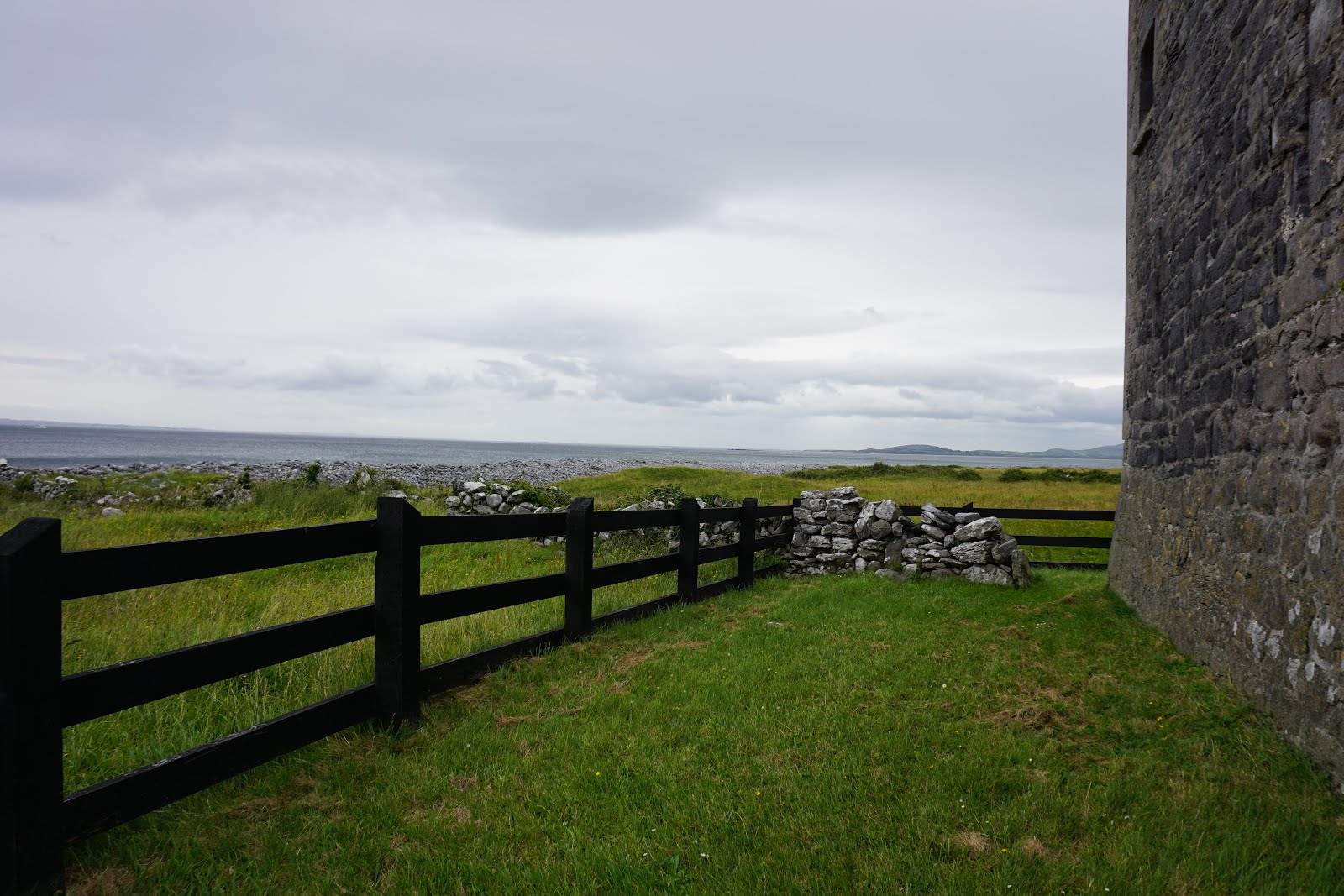
Here's a picture of Ireland, just as an added bonus! (for more pictures of Ireland, read about our trip here, here, here, and here.


The Verdict:
The bread was a hit with everyone but Ebabe.  She didn't want to try it and had made up her mind that she wasn't going to like it before she did, so of course she didn't.  I like the savory sweetness!  As for the stew, the oldest kiddo liked it, the middle said it was okay, and the youngest liked the meat and potatoes but not the broth or vegetables.  I thought it was a bold flavor, and while it won't be one of my favorite recipes, it was tasty!


Dairy-Free Irish Soda Bread (original recipe from McCormick Spices, made dairy-free on Go Dairy Free)   I'm adding it on here because the directions were not completely clear about creating the dairy-free buttermilk in the recipe and I didn't want anyone else having a problem with that!

Ingredients:


  • 2½ cups flour
  • ½ cup sugar
  • 2 tsp caraway seed
  • 1½ tsp baking powder
  • ½ tsp baking soda
  • 1 tsp ground cinnamon
  • ½ tsp salt
  • ½ cup raisins
  • 1 TBSP apple cider vinegar or white vinegar
  • 1¼ cups almond milk
  • 2 eggs
  • ½ tsp pure vanilla extract
Instructions

Preheat oven to 350°F. Grease 9-inch round cake pan.  Mix the flour, sugar, caraway seed, baking powder, baking soda, cinnamon and salt in large bowl. Stir in raisins. 


In a medium bowl, add almond milk and apple cider vinegar and stir together.  Don't worry if it curdles a little.  Mix milk mixture, eggs and vanilla, then slowly stir into dry ingredients. Do not over mix. Pour batter in prepared pan and bake 45 to 50 minutes (until toothpick inserted in center comes out clean).


Cool in the pan on a wire rack for 10 minutes. Remove from pan and allow to cool completely on the wire rack.


Irish Stew (original recipe from Coley Cooks) - I followed this one exactly (yes, I used Guinness and peeled my potatoes!) so if you want the recipe, click the link.


At one point during planning, I had hoped we'd have enough time to go into Dublin before our flight to Cardiff.  Having a rental car to return to the airport and then all our luggage in tow made that nearly impossible.  Then I thought that maybe we'd have time to go to the Kildare Maze but it didn't open until noon, which gave us very little time to enjoy the hedge maze and activities, get to Dublin and return the car before our flight.  We decided last night that we would try to make one brief stop on the way from Limerick back to Dublin so we would have time to eat, get gas, and get to our flight on time.  I spent some time researching ruins and castles on our route and the amount of time it would take to get to them, tour them, and get back on the road.

We finally decided to stop at Nenagh Castle.  From the information sign at the ruins,
"Nenagh was built as a military castle by Theobald FitzWalter, who came to Ireland at the time of the Anglo-Norman invasion in the latter half of the 12th century."

"The circular keep was probably constructed around 1200.  It served residential, administrative and military functions.  This multi-purpose role is reflected in the architecture of the Castle with walls 5m thick at basement level, an original entrance door at the first floor level. The keep had flanking towers with a defensive curtain wall, but there were demolished after the Williamite wars. The partial remains of the entrance gatehouse had a defensive portcullis and a drawbridge over a moat. The building at the rear of the gatehouse had two chambers, divided by the entrance passage at ground floor level with a large baronial half at first floor."

 "The topmost part of the circular keep was added in the 19th century and it was intended to be used as a belfry."

 "The Butlers resided here continually until the end of the 14th century when they moved to Gowran and again to Kilkenny Castle. In the 15th century, Nenagh was in the hands of the MacIbrien family, but by 1533 Sir Piers Butler, Earl of Ossory had returned to regain possession. However, in 1548, the Irish, under O'Carroll, burned it.  The castle had a chequered history and changed hands many times up until the end of the Williamite wars, after which, it was rendered harmless."

During our brief stop, the girls and I needed to use the restroom.  There was a self-cleaning pod that cost a Euro to use, but when nature calls, you have to answer. Chip and I had seen these on television but never in person.  The experience was interesting and the girls thought it was fun.

After a slight fiasco trying to find a gas station when we were laying on empty (only time we had to fill-up the car!) and the road signs that tell you to get off the highway but don't tell you which of the multiple round-abouts you should take to reach said gas station, we were able to return the car.  This lead to a further fiasco with the rental car agency claiming that a small scratch on the car was going to potentially cost $1800 to fix and charging the entire potential cost to our credit card!  They had also overcharged us for the per day insurance coverage. We are still arguing that point with Enterprise, but we made it to the gate on time.

Once at our gate, the airline bused us out onto the tarmac to board the plane.  It was very windy and we all hoped that no one dropped their passport as they climbed aboard.


The flight was about an hour and we landed in Cardiff, Wales with no issues.  There was no customs agent and we walked pretty much directly from the plane to the bus stop.

We took the bus to Cardiff Bay, walked about a mile to the hotel and got checked in.  We ended up with two non-adjacent rooms and the older girls decided they wanted to be in the second room by themselves.


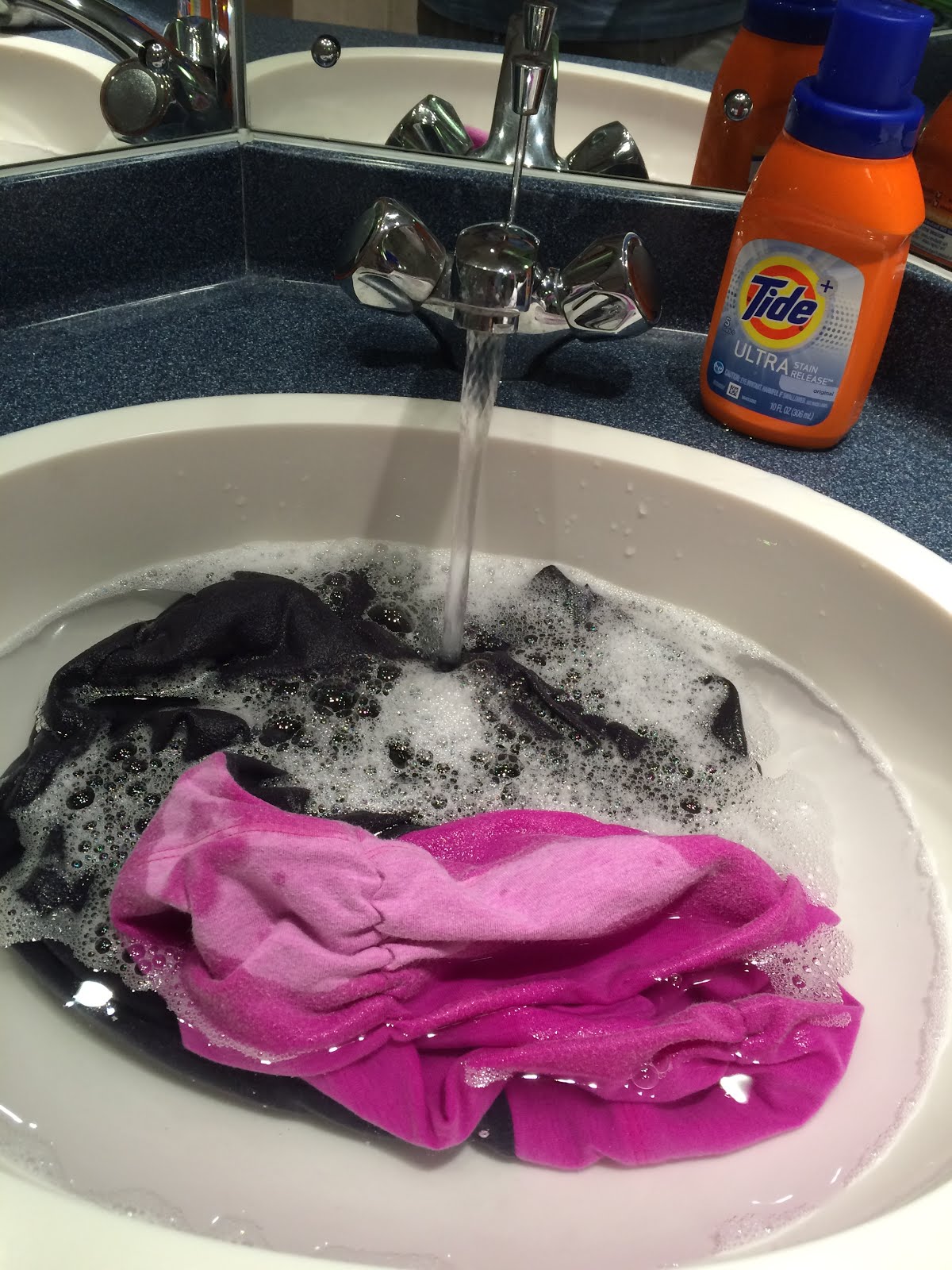
We had thought that this hotel had laundry facilities, based on the website, but it did not.  Having packed 5 days worth of clothes for our 10 day trip, I ended up doing the wash in our bathroom sink and hanging clothes around the room to dry.


After getting the clothes hung to dry, we headed out and walked down to Mermaid Quay to find some dinner, passing the Wales Millenium Center on our way.


A large food festival had just ended and though the booths had all closed, there were people everywhere along the main paths.  We backtracked and took a different route to the waterfront.


Once at the waterfront, we found some stairs and wandered down on to the wharf, only to stumble upon the Ianto Shrine, a wall dedicated to a character on the television show, Torchwood.


Hoping the crowds had thinned a bit, we made our way back up to the main level at Mermaid Quay.  Many of the restaurants were still crowded and the younger kids were getting crabby, so we decided to stop at Eddie's American Cafe.  Imagine our surprise when we realized that scenes from several episodes of Doctor Who had been filmed inside the restaurant!

The food was good and the excitement that some of their favorite actors had been here was icing on the cake for the kids.


We stopped at a giant egg statue for a photo on the walk back to the hotel and have settled in for a quiet night!

Well, dinner last night was a fiasco, but we woke up rested and ready to go this morning. 

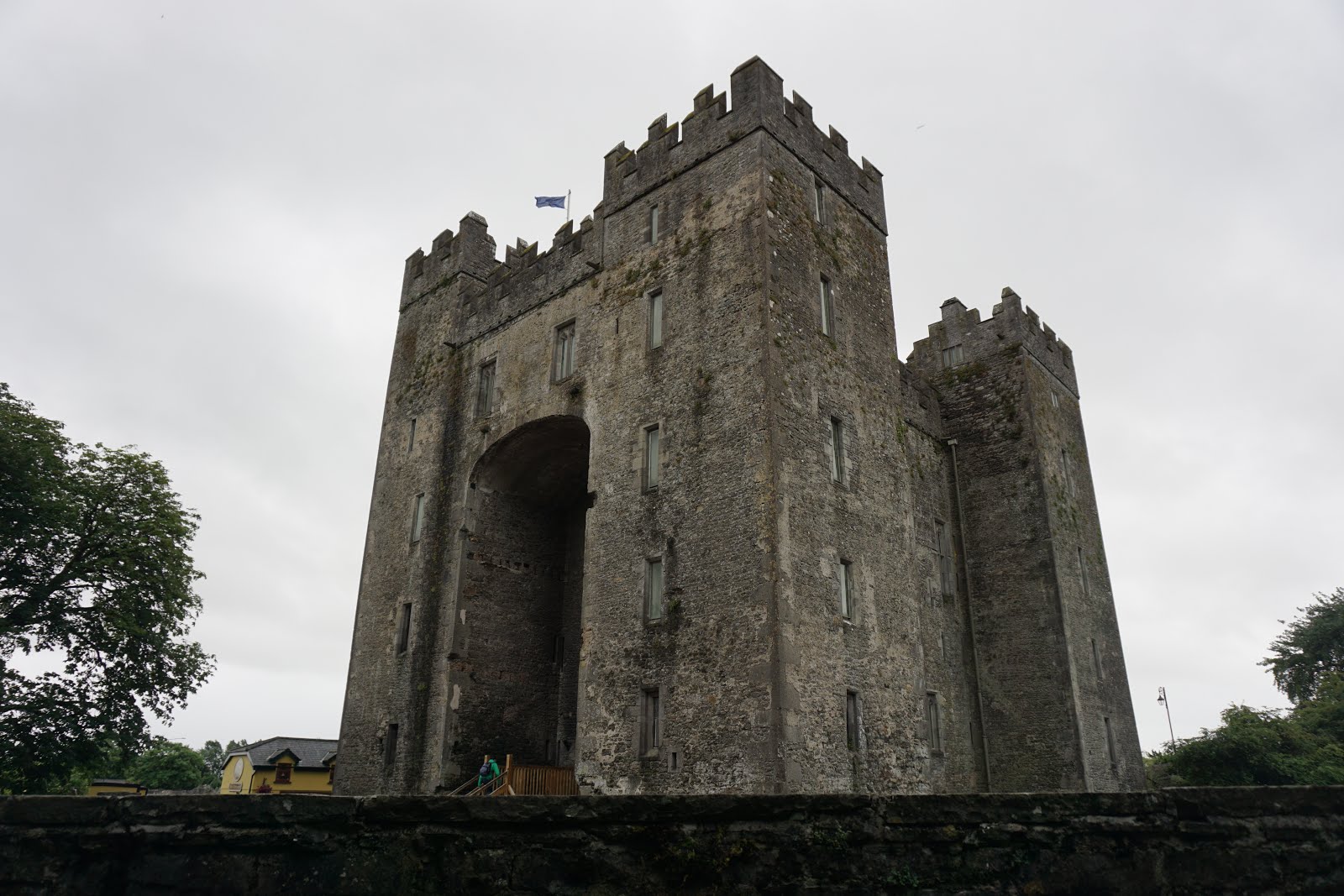
Today's adventure was Bunratty Castle and Folk Park, a location only a few kilometers from our hotel.

A brief history of the castle, quoted from the Shannon Heritage website:
"The site on which Bunratty Castle stands was in origin a Viking trading camp in 970. The present structure is the last of four castles to be built on the site.  Robert De Muscegros, a Norman, built the first defensive fortress (an earthen mound with a strong wooden tower on top) in 1250. His lands were later granted to Thomas De Clare who built the first stone castle on the site. About this time Bunratty became a large town of 1,000 inhabitants."
  "In 1318 Richard De Clare, son of Thomas was killed in a battle between the Irish and the Normans. His followers were routed and the castle and town were completely destroyed. The castle was restored for the King of England but was laid waste in 1332 by the Irish Chieftains of Thomond under the O'Briens and MacNamaras. It lay in ruins for 21 years until it was rebuilt by Sir Thomas Rokeby but was once again attacked by the Irish and the castle remained in Irish hands thereafter."

"The powerful MacNamara family built the present structure around 1425 but by 1475 it had became the stronghold of the O'Briens, the largest clan in North Munster. They ruled the territory of North Munster and lived in great splendor. The castle was surrounded by beautiful gardens and it was reputed to have a herd of 3,000 deer."

"Under Henry VIII's 'surrender and re-grant scheme, the O'Brien's were granted the title 'Earls of Thomond' and they agreed to profess loyalty to the King of England. The reign of the O'Briens came to an end with the arrival of the Cromwellian troops and the castle and its grounds were surrendered."

"Bunratty Castle and its lands were granted to various Plantation families, the last of whom was the Studdart family. They left the castle in 1804 (allowing it to fall into disrepair), to reside in the more comfortable and modern Bunratty House."

"Bunratty returned to its former splendor when Viscount Lord Gort purchased it in 1954. The extensive restoration work began in 1954 with the help of the Office of Public Works, the Irish Tourist Board and Shannon Development."
 "It was then opened to the public in 1962 as a National Monument and is open to visitors year round. It is the most complete and authentically restored and furnished castle in Ireland."

The castle is a self-guided tour though all the rooms, most are furnished.  You can climb up to the parapets and enjoy the views from the top of the towers.


 The castle is full of gorgeous woodwork and stained glass windows.  


Within the grounds of the castle is the folk park, where 19th Century life is vividly recreated. Set on 26 acres, the impressive park features over 30 historic buildings. 

Villager's House
 
Schoolhouse
Shannon Farmhouse
Golden Vale Farmhouse (baking demonstration)
Doctor's House
Vertical Mill
Ardcroney Church, moved stone by stone from County Tipperary

One of our favorite features of the Folk Park was the walled garden. Such a serene place and it smelled amazing!


Touring all the buildings and grounds in the Folk Park took the majority of the day.  We left around 4pm and headed back to the hotel, making a quick stop to check out Cratloemoyle, a castle ruin we could see from the hotel.


We decided to go to the pool when we got back to the hotel, since it was within the children's swimming hours.  The girls were required to have a fabric swim cap in order to use the pool.  Apparently there is some sort of sanitary law that requires spas and hotels to have long hair covered while swimming. 


After our swim (or soak in the hot tub for those of us over 18), we went to the pub for dinner.  There was a sporting match on television and we spent 15 minutes trying to figure out what sport it was.  We finally figured out it was hurling.  The match was County Limerick vs County Claire and quite interesting to watch.


Now we are back in the room and ready to pack the suitcases for our departure in the morning.  We will be driving back to Dublin and catching a plane to Cardiff, Wales!  I can't believe how quickly the days are going by.
Rural farmhouses, village shops and streets are recreated and furnished as they would have appeared at that time according to their social standing, from the poorest one roomed dwelling to Bunratty House a fine example of a Georgian residence for the gentry - See more at: http://www.shannonheritage.com/BunrattyCastleAndFolkPark/BunrattyFolkPark/#sthash.wMVbGg7p.dpuf


In 1318 Richard De Clare, son of Thomas was killed in a battle between the Irish and the Normans. His followers were routed and the castle and town were completely destroyed. The castle was restored for the King of England but was laid waste in 1332 by the Irish Chieftains of Thomond under the O'Briens and MacNamaras. It lay in ruins for 21 years until it was rebuilt by Sir Thomas Rokeby but was once again attacked by the Irish and the castle remained in Irish hands thereafter. - See more at: http://www.shannonheritage.com/BunrattyCastleAndFolkPark/BunrattyCastle/#sthash.CDYGKgPY.dpuf
Robert De Muscegros, a Norman, built the first defensive fortress (an earthen mound with a strong wooden tower on top) in 1250. His lands were later granted to Thomas De Clare who built the first stone castle on the site. About this time Bunratty became a large town of 1,000 inhabitants.

In 1318 Richard De Clare, son of Thomas was killed in a battle between the Irish and the Normans. His followers were routed and the castle and town were completely destroyed. The castle was restored for the King of England but was laid waste in 1332 by the Irish Chieftains of Thomond under the O'Briens and MacNamaras. It lay in ruins for 21 years until it was rebuilt by Sir Thomas Rokeby but was once again attacked by the Irish and the castle remained in Irish hands thereafter. - See more at: http://www.shannonheritage.com/BunrattyCastleAndFolkPark/BunrattyCastle/#sthash.CDYGKgPY.dpuf
The site on which Bunratty Castle stands was in origin a Viking trading camp in 970. The present structure is the last of four castles to be built on the site. - See more at: http://www.shannonheritage.com/BunrattyCastleAndFolkPark/BunrattyCastle/#sthash.CDYGKgPY.dpuf
The site on which Bunratty Castle stands was in origin a Viking trading camp in 970. The present structure is the last of four castles to be built on the site.

Early History

Robert De Muscegros, a Norman, built the first defensive fortress (an earthen mound with a strong wooden tower on top) in 1250. His lands were later granted to Thomas De Clare who built the first stone castle on the site. About this time Bunratty became a large town of 1,000 inhabitants.

In 1318 Richard De Clare, son of Thomas was killed in a battle between the Irish and the Normans. His followers were routed and the castle and town were completely destroyed. The castle was restored for the King of England but was laid waste in 1332 by the Irish Chieftains of Thomond under the O'Briens and MacNamaras. It lay in ruins for 21 years until it was rebuilt by Sir Thomas Rokeby but was once again attacked by the Irish and the castle remained in Irish hands thereafter.

MacNamaras and O’Briens

The powerful MacNamara family built the present structure around 1425 but by 1475 it had became the stronghold of the O'Briens, the largest clan in North Munster. They ruled the territory of North Munster and lived in great splendor. The castle was surrounded by beautiful gardens and it was reputed to have a herd of 3,000 deer.

Under Henry VIII's 'surrender and re-grant' scheme, the O'Brien's were granted the title 'Earls of Thomond' and they agreed to profess loyalty to the King of England. The reign of the O'Briens came to an end with the arrival of the Cromwellian troops and the castle and its grounds were surrendered. The O'Briens never returned to Bunratty but later they built a beautiful residence at Dromoland Castle, now a luxury 5 star hotel.

Plantation Families

Bunratty Castle and its lands were granted to various Plantation families, the last of whom was the Studdart family. They left the castle in 1804 (allowing it to fall into disrepair), to reside in the more comfortable and modern Bunratty House, which is open to the public in the grounds of the Folk Park.
Bunratty returned to its former splendor when Viscount Lord Gort purchased it in 1954. The extensive restoration work began in 1945 with the help of the Office of Public Works, the Irish Tourist Board and Shannon Development. It was then opened to the public in 1962 as a National Monument and is open to visitors year round. It is the most complete and authentically restored and furnished castle in Ireland.
- See more at: http://www.shannonheritage.com/BunrattyCastleAndFolkPark/BunrattyCastle/#sthash.CDYGKgPY.dpuf
Today we explored the Burren.  What is the Burren?  Well, it's the northwestern corner of County Clare, bordered by the Atlantic Ocean and the quieter waters of Galway Bay, and it is a rock garden like you've never seen before. The Burren extends over more than a hundred square miles and most of it is bare, pale grey limestone. 
 
First stop: Killinaboy Church Ruins (description below from Megalithic Ireland
"The church at Killinaboy is believed to be a late medieval rebuild of a earlier 13th century church. The name Killinaboy is derived from the Irish Cill Iníne Baoith, meaning "Church of Baoith's daughter" who is reputed to be the founder of the original monastery here. The most striking feature of the church is the double barred Cross of Lorraine that is built into the west gable."
"The Cross of Lorraine was a form or shape of reliquary used in Central Europe to enshrine fragments of the true Cross. The first relic of the true cross in Ireland was enshrined in the Cross of Cong which dates to the early 12th century. Further fragments of the cross appeared in Ireland after that date. Harbison has suggested that the cross integrated into the west gable may imitate a reliquary of the true cross that may have been kept in Killinaboy church around the 13th century."

 "The north and west walls of the 19.20 meter long church are probably 13th century and the East window is much later."

 "To the north of the altar is a 15th century ambry."

"To the north of the church is the stump of an 11th century round tower."

"An excellent sheela stands just above the late medieval entrance in the south wall. There are traces of incised ribs on the sheela's right hand side. Her hands appear to meet just above the vulva. Local tradition believes it represents the first abbess and founder of the monastery Inline Bait." 

It was interesting how the church ruins have been used for burial sites.  It added a further sense of reverence to the visit.


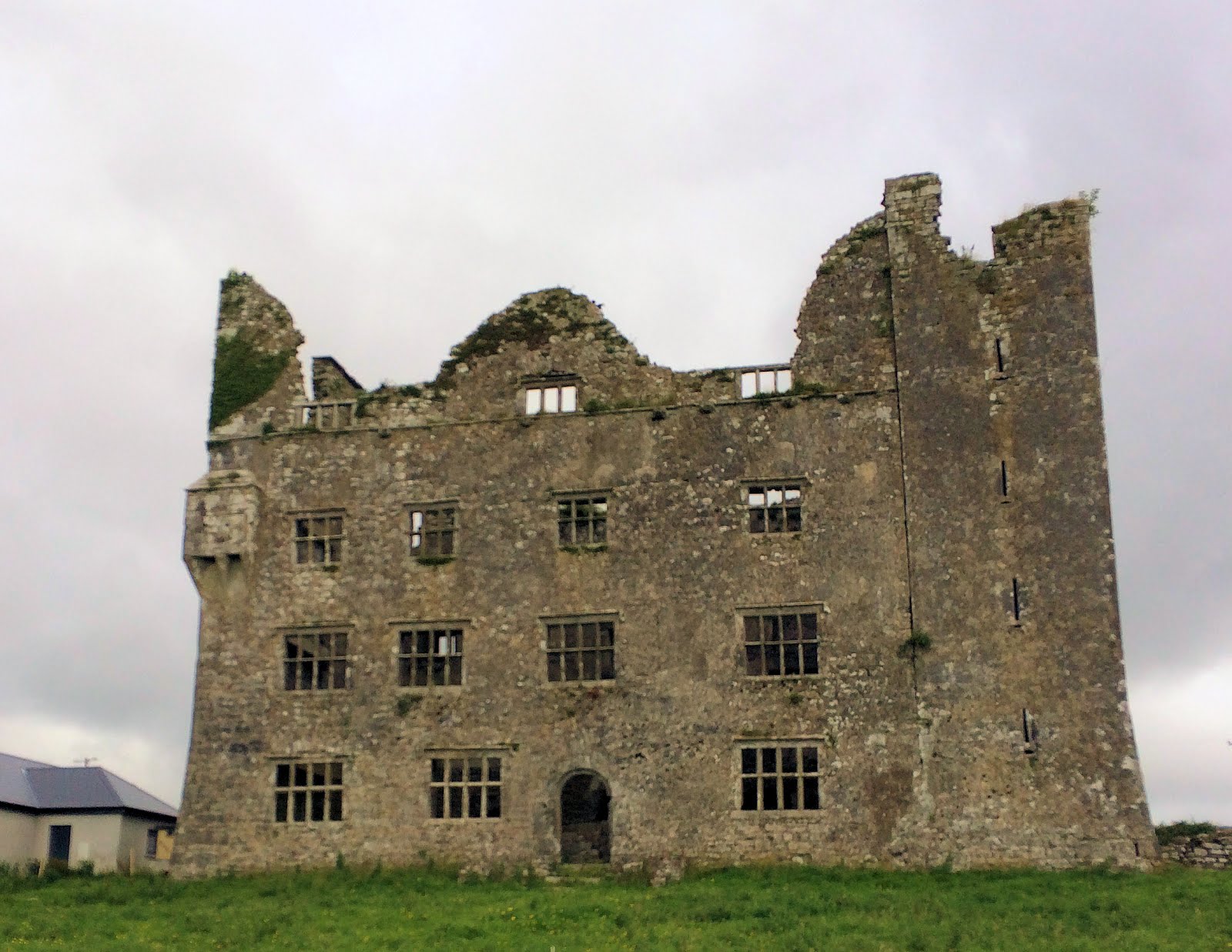
Our next stop, Leamenagh Castle Ruins, wasn't a stop but more of a drive by on the way to our next stop. You can read more about the history of the house here.


Not too much further up the road is Caherconnell.  A caher is a ringfort, or an enclosed farmstead, and this particular one was the caher of someone named Connell. Caherconnell is bigger than most ringforts and was built in the 10th century by a well-to-do family, possibly one of the ruling families in the area.  It is also an active archaeological project.


The walking tour includes a guidebook which describes the area, the different archaeological digs that have occurred, photos of artifacts found, and a time line of Irish archaeology.


This is a burial area.  The cist on the left contained the remains of a toddler and a baby, while the larger right one held the remains of a 45-year old woman.


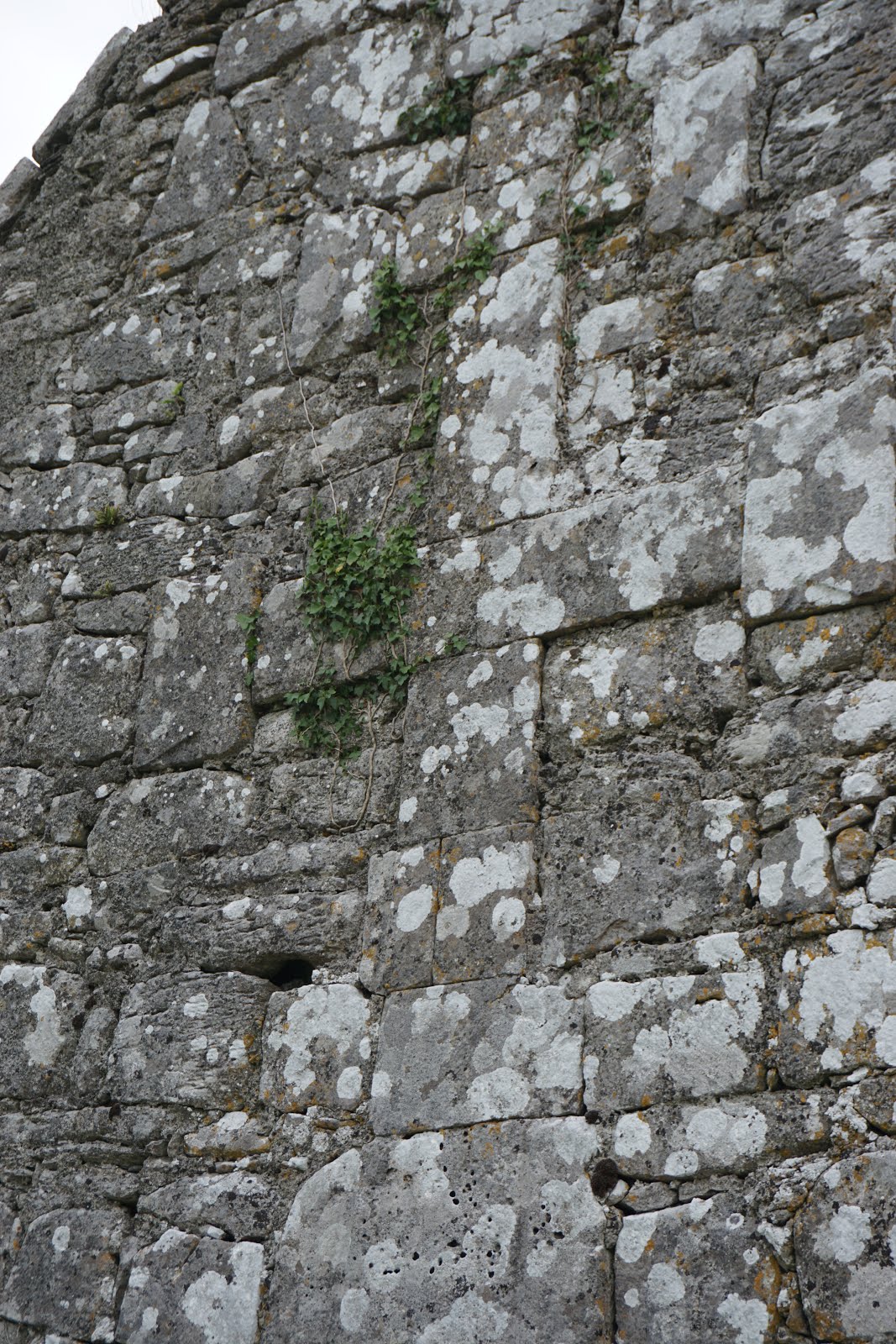
The fort walls are made of drystone construction.  That means that no mortar was used to build it.  The wall slopes slightly inwards, making it more stable, and is quite deep.  The photo below was taken shooting into one of the gaps in the stone.  It is about an adult arm-length deep.


This sub-circular structure was built in medieval times and was used for food storage.  Nearby was an early Bronze Age timber-framed house, marked by modern timbers.

We had opted not to stay for a sheep dog demonstration because of the timing, but while we were exploring the caher, one of the shepherds was training one of the dog, so we got a glimpse of how the sheep dog handles herding the sheep. 


About a kilometer down the road, we stopped at the Poulnabrone Dolman. The dolman, or portal tomb, was excavated in 1986, has been carbon dated to between 3800 - 3600 BC and is the final resting place for the remains of 30 individuals from the Neolithic age. The name Poulnabrone means 'The hole of the sorrows.'


The original capstone was found to be cracked during the excavation and was replaced.  The slab on the ground behind the tomb is the original capstone.


Poulnabrone is situated in a karst limestone plateau, 150 meters above sea level.


Poulnabrone is a great place to see features of the Burren's karst landscape.


The crevasses in the limestone are called grikes, which form between blocks of limestones called clints.  Grikes are just one of the many types of karst features that form when rainwater dissolves limestone.


Kamenitza are small hallows that form on limestone surfaces due to rainwater dissolution.  Rainwater is slightly acidic and it dissolves limestone.  Solution channels called rillenkaren form where water flows off the sides of the limestone pavement.


Large rocks were transported by ice sheets during the last Ice Age and deposited when the ice melted. These rocks are called Glacial Erratics.  


The Burren is less than 0.5% of the area of Ireland but contains flora representing 70% of the country's 900 native plants. 


A short trip down the mountain and we were at our next stop, Aillwee Cave and the Burren Birds of Prey Center.

We got there just in time for the Birds of Prey flying display. Below is the vulture.


Bug got to help in the demonstration, getting a chance to hold Jon Snow (the snowy owl).


We learned a lot about the different birds and what issues they face living in the wild.  The final demonstration was the falcon and she was a beauty!


After the demonstration we drove up the mountain to get to the cave entrance and were entranced by the view of valley bordered by Galway Bay from the parking lot.


The Aillwee Cave is one of the oldest caves in Ireland, formed during the 1st Ice Age was discovered in 1944 when a farmer's dog chased an animal down a hole.  When the dog didn't return right away, the farmer followed him into the hole and discovered the remains of brown bears in what is believed to be a hibernation nest.


There are some interesting formations in the cave, including what they call a frozen waterfall.


At one point, the tour guide turned off all the lights and showed us just how dark the cave could be.  It was pretty amazing! The tour finishes near an underground waterfall.


Next up on our Burren tour were the ruins of Gleninagh Castle.  On the way there, we stopped to view the Pinnacle Well, which you can read more about here


The road that leads to the Gleninagh Castle ruins was really just two ruts with lots of potholes and was overgrown with lots of vines and greenery.  Chip successfully navigated us back into the unknown, while I spent the time flinching every time we hit a bump and praying that there wasn't anyone else (car, bike, or pedestrian) on the road ahead.

Looking back down the lane from the widest area 

It was worth the 5 minutes of stress to see the beautiful views of Galway Bay from the castle lands.


Description below from Ireland's Eye 
"Looking down from a hillside across the wide expanse of Galway Bay, this well-preserved sixteenth-century tower house stands guard over the northern shoreline of the Burren. It has a distinctive L-shaped plan comprising an oblong tower of four storeys with a projecting turret."

 "The entrance doorway lies at first-floor level with a protecting machicolation high above in the turret."


 "Striking round bartizans are present on three corners of the main tower, while an attic in its roof was contained behind gables on all four sides."
  "The third storey is vaulted and there is another over a dark basement, which may have been used as a prison. In the end wall a number of window embrasures were later blocked for fireplaces." 
 
  "The castle was built for the O'Loughlins, who were still resident in the 1840s. It remained occupied until the 1890s."
 You can read more about the history of the castle here.

On the property is the Well of the Holy Cross.


We parked right at the remains of a church, but didn't get to explore it because the vegetation was so thick and it was beginning to rain.  Also, we were behind schedule and wanted to make sure we had time to finish our drive.


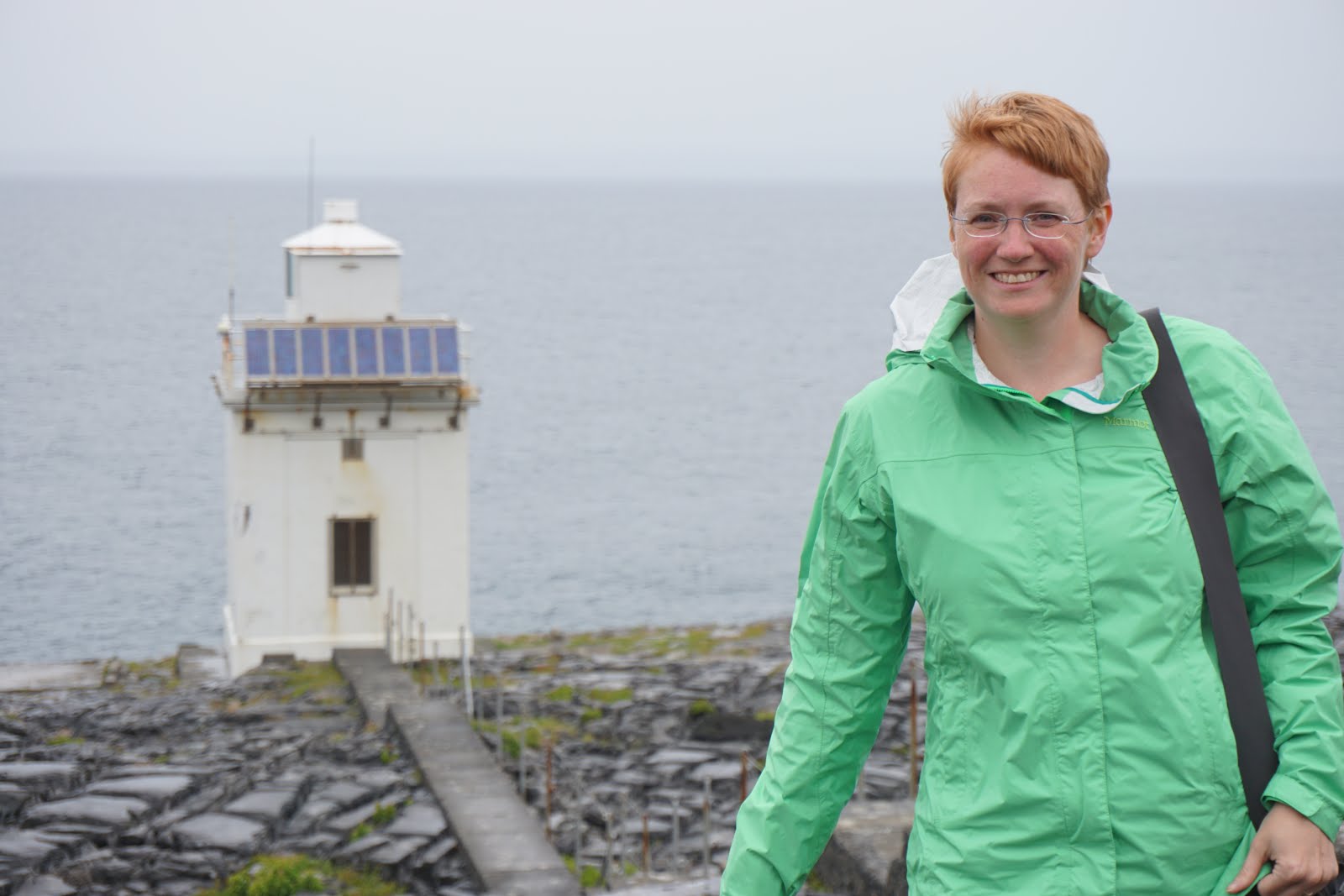
Continuing our drive, we stopped briefly at Black Head Light, the northerly most tip of County Clare.  Its name in Irish is Ceann Boirne or Burren Head.


 It was a beautiful drive along the ocean as we made our way closer to Liscanor. 
 
When we arrived at our final destination, the Cliffs of Moher, it was raining and windy and we missed getting to visit the Tower of O'Brien by 30 minutes.  


 The rain gave the cliffs a mythical feel.


Bug trying not to blow away while standing at O'Brien's Tower.

By the time we were done looking at the cliffs, we were all drenched, so of course we took a family selfie!


Thankfully we all dried almost completely during the car ride back to the hotel.  We just ordered room service for dinner and are planning on having a less busy day tomorrow.